Why Concrete Fails in the Field Even When the Mix Design is Correct
Concrete often fails on site despite a correct mix design. Common causes include poor batching, excess water, low-quality aggregates, improper compaction, inadequate curing, and delayed placement. This blog offers practical tips for civil engineers and site professionals to ensure durable, reliable concrete
BLOGS BY ENGR AHMAD SHAHZAD
ENGR AHMAD SHAHZAD
3/26/20263 min read
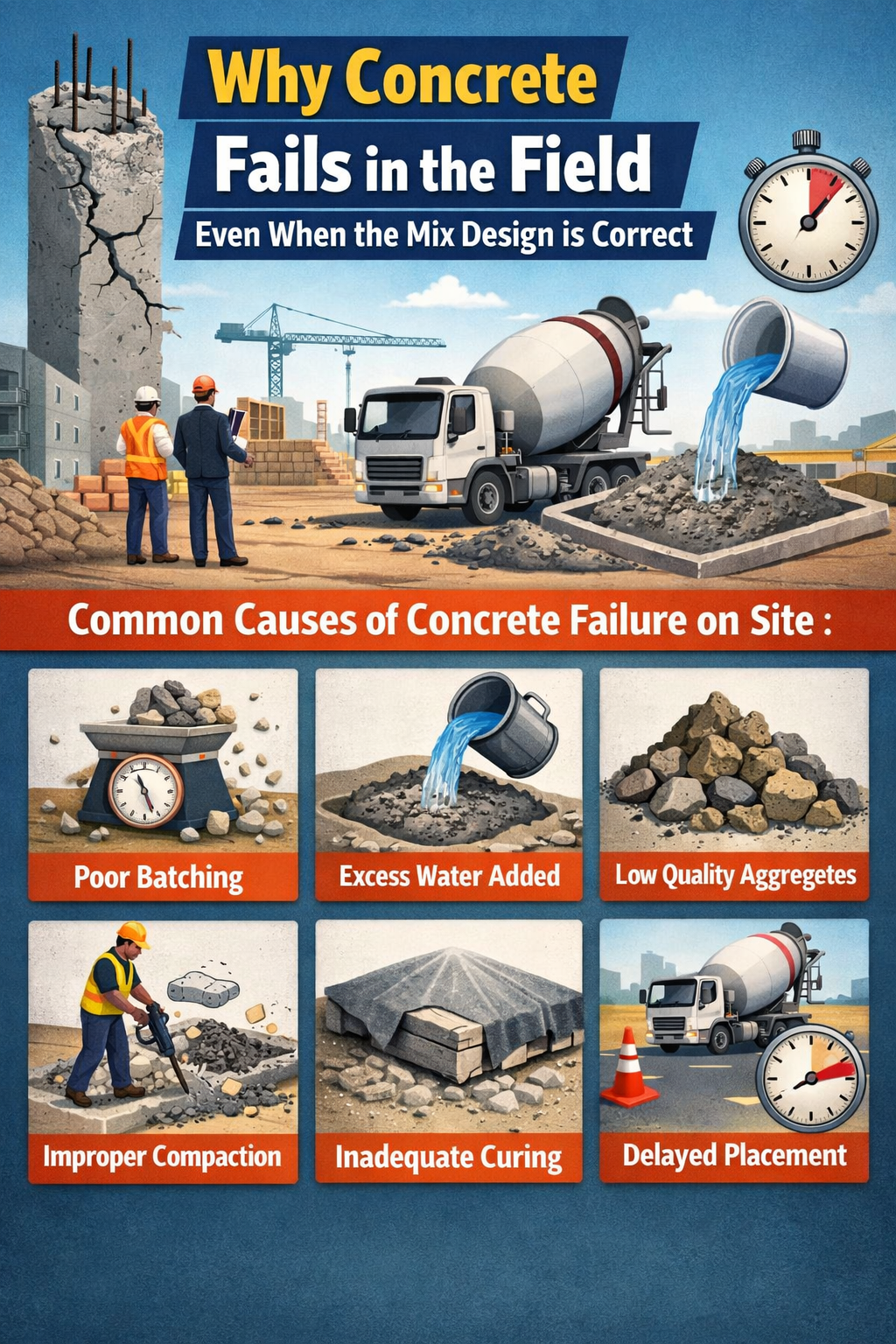
Concrete is the backbone of modern construction. Engineers carefully prepare a concrete mix design to achieve the required strength, durability, and workability. However, many construction projects still experience concrete failure in the field, even when the laboratory mix design is technically correct.
This raises an important question: why does concrete fail on-site despite having a proper mix design?
The reality is that most failures occur due to poor field practices rather than design errors. From improper batching to inadequate curing, several practical issues can significantly reduce the strength and performance of concrete.
In this article, we will explore the most common real-life reasons for concrete failure in construction sites and practical solutions civil engineers can apply to prevent them.
1. Poor Batching and Incorrect Material Proportions
Even when a mix design is properly prepared in the lab, the actual batching on-site may not follow the specified proportions.
Common problems include:
Using volume batching instead of weight batching
Incorrect measurement of sand or aggregate
Excess cement or reduced cement content
Lack of proper supervision during mixing
When proportions change, the water-cement ratio and aggregate balance are disturbed, which directly affects compressive strength and durability.
Practical Solution
Civil engineers should ensure:
Use of weigh batching whenever possible
Proper calibration of batching equipment
Strict supervision during mixing operations
2. Excess Water Added on Site
One of the most common causes of weak concrete is the addition of extra water at the construction site.
Workers often add water to increase workability or slump, especially when transporting concrete over long distances.
However, increasing the water-cement ratio leads to:
Lower compressive strength
Increased porosity
Higher permeability
Greater risk of cracking
This is why many structures fail even though the original mix design was correct.
Practical Solution
Instead of adding water:
Use plasticizers or superplasticizers
Maintain proper slump control
Train workers about the impact of water addition
3. Poor Quality Aggregates
Aggregates make up about 60–75% of concrete volume, so their quality plays a major role in concrete performance.
Concrete can fail when aggregates have:
High silt or clay content
Weak or porous particles
Improper grading
Contaminants like organic material
Poor aggregates reduce the bond between cement paste and aggregate, resulting in lower strength.
Practical Solution
Engineers should ensure:
Proper sieve analysis
Silt content testing
Use of approved aggregate sources
Routine quality control checks
4. Improper Compaction of Concrete
Even a perfect mix design will fail if concrete is not compacted properly.
Insufficient vibration leads to:
Air voids
Honeycombing
Weak zones in structural elements
These defects significantly reduce structural strength and durability.
Practical Solution
Use mechanical vibrators
Ensure proper vibration duration
Avoid both under-vibration and over-vibration
Proper compaction ensures concrete achieves its designed density and strength.
5. Poor Curing Practices
Curing is one of the most neglected aspects of concrete construction.
Concrete requires moisture for the hydration process. Without proper curing:
Strength development slows down
Surface cracks develop
Durability decreases
In hot climates, this problem becomes even more severe.
Practical Solution
Engineers should ensure:
Continuous curing for at least 7–14 days
Use of wet coverings, curing compounds, or water ponds
Protection from direct sunlight and wind
6. Delayed Placement and Transportation Problems
When concrete takes too long to reach the placement area, it begins to lose workability and initial setting may start.
Common issues include:
Traffic delays
Long transportation distances
Improper handling
This can lead to cold joints, poor bonding, and reduced strength.
Practical Solution
Proper construction planning
Maintain a reasonable transport time
Use retarding admixtures when necessary
7. Lack of Site Supervision
Many construction failures occur simply because quality control procedures are not followed on-site.
Without proper supervision:
Workers may change the mix proportions
Water may be added without approval
Compaction and curing may be ignored
This results in concrete that performs far below its design strength.
Practical Solution
A qualified site engineer or quality control engineer must monitor:
Batching
Mixing
Placement
Compaction
Curing
Regular cube strength testing should also be conducted to verify performance.
Final Thoughts
Concrete failure in the field is rarely caused by a faulty mix design. In most cases, the real problem lies in poor construction practices, lack of quality control, and improper handling of materials on site.
For civil engineers, understanding these practical issues is essential to ensure strong, durable, and reliable concrete structures.
By focusing on proper batching, water control, aggregate quality, compaction, curing, and site supervision, engineers can significantly reduce the chances of concrete failure and improve overall construction quality.